Introduction
Managing a growing workforce is more challenging than ever. Human Resources (HR) teams are expected to handle recruitment, employee records, attendance, leave management, performance tracking, compliance, payroll coordination, and employee engagement—all while ensuring a positive employee experience.
When these processes rely on spreadsheets, paper documents, and disconnected software, HR teams spend valuable time on repetitive administrative tasks instead of focusing on strategic initiatives that drive business growth.
This is where an Enterprise Resource Planning (ERP) system transforms HR operations. By centralizing employee information and automating routine processes, an ERP enables HR teams to work faster, reduce errors, improve collaboration, and make better decisions.
In this guide, we’ll explore how an ERP system helps HR departments streamline their daily operations and why businesses of all sizes are adopting ERP solutions for smarter workforce management.
Why HR Teams Need an ERP System
As organizations grow, HR responsibilities become increasingly complex. Managing hundreds or thousands of employee records manually often results in:
- Duplicate employee data
- Delayed approvals
- Payroll errors
- Attendance inconsistencies
- Lost recruitment information
- Inefficient communication
- Compliance challenges
An ERP system brings all HR activities together into one centralized platform, giving HR professionals instant access to accurate information whenever they need it.
1. Centralized Employee Information Management
Employee information is one of the most valuable assets for any organization. Instead of storing records across spreadsheets, emails, and paper files, an ERP system keeps everything securely in one location.
The employee profile typically includes:
- Personal information
- Contact details
- Employment history
- Department
- Designation
- Reporting manager
- Salary structure
- Documents
- Performance records
- Training history
Because information is updated in real time, HR teams always work with the latest employee data.
Benefits
- Faster access to employee information
- Reduced paperwork
- Improved data accuracy
- Better compliance
- Secure document storage
2. Automated Attendance and Time Tracking
Tracking attendance manually becomes difficult as the workforce grows. ERP software automates attendance by integrating with biometric devices, mobile apps, or web-based check-ins.
HR managers can monitor:
- Daily attendance
- Late arrivals
- Early departures
- Overtime
- Shift schedules
- Absent employees
- Holiday calendars
Automated attendance records improve payroll accuracy while reducing manual effort.
Benefits
- Eliminate attendance errors
- Simplify payroll calculations
- Improve workforce visibility
- Monitor employee punctuality
- Generate attendance reports instantly
3. Simplified Leave Management
Handling leave requests through emails or paper forms can create confusion and delays.
An ERP system allows employees to submit leave requests through a self-service portal. Managers receive notifications, review requests, and approve or reject them in just a few clicks.
Employees can also view:
- Leave balances
- Leave history
- Holiday calendar
- Approval status
Benefits
- Faster approvals
- Transparent leave tracking
- Reduced administrative work
- Better workforce planning
- Improved employee experience
4. Smarter Recruitment Management
Hiring involves multiple stages—from posting job openings to onboarding new employees.
An ERP recruitment module organizes every step in one place.
Recruiters can:
- Publish job openings
- Collect applications
- Screen resumes
- Schedule interviews
- Track candidate progress
- Share feedback
- Generate offer letters
Instead of searching through emails, recruiters have complete visibility into the hiring pipeline.
Benefits
- Faster hiring process
- Better collaboration
- Organized candidate database
- Reduced manual work
- Improved hiring decisions
5. Faster Employee Onboarding
The first few days significantly influence a new employee’s experience.
ERP systems automate onboarding by assigning tasks such as:
- Document submission
- ID creation
- IT equipment allocation
- Policy acknowledgments
- Department introductions
- Training schedules
HR teams can monitor onboarding progress from a single dashboard.
Benefits
- Consistent onboarding process
- Reduced paperwork
- Better employee experience
- Faster productivity
- Improved compliance
6. Timesheets and Work Hour Tracking
For project-based businesses, tracking employee work hours is essential.
ERP timesheets allow employees to log hours against projects and tasks while managers monitor progress in real time.
This enables organizations to:
- Measure productivity
- Track billable hours
- Estimate project costs
- Improve resource allocation
Benefits
- Accurate work-hour records
- Better project planning
- Increased accountability
- Simplified client billing
- Performance insights
7. Employee Expense Management
Business travel, client meetings, and operational expenses often generate reimbursement requests.
ERP software enables employees to submit expenses digitally along with receipts.
Managers can:
- Review claims
- Approve expenses
- Track reimbursements
- Monitor spending trends
Finance teams receive complete visibility into employee expenses.
Benefits
- Faster reimbursements
- Reduced paperwork
- Better expense control
- Digital approval workflows
- Transparent financial records
8. Calendar and Task Management
HR departments manage interviews, training sessions, compliance deadlines, employee events, and performance reviews.
An ERP calendar keeps everything organized by allowing teams to:
- Schedule meetings
- Book interview slots
- Assign reminders
- Track deadlines
- Coordinate company events
Task management ensures important activities never get overlooked.
Benefits
- Better scheduling
- Improved collaboration
- Fewer missed deadlines
- Increased productivity
- Organized HR operations
9. Better Internal Communication
Effective communication keeps teams aligned and engaged.
Many ERP platforms include built-in communication tools that enable employees and HR teams to:
- Share announcements
- Discuss projects
- Send notifications
- Collaborate across departments
- Resolve employee queries
Keeping communication inside the ERP improves transparency and reduces dependency on scattered emails.
Benefits
- Faster information sharing
- Better collaboration
- Increased employee engagement
- Centralized communication history
10. HR Analytics and Reporting
Modern HR decisions should be based on data rather than assumptions.
ERP systems generate real-time reports covering:
- Employee turnover
- Attendance trends
- Recruitment performance
- Leave utilization
- Workforce costs
- Department productivity
- Employee growth
These insights help leadership make informed strategic decisions.
Benefits
- Data-driven HR decisions
- Better workforce planning
- Improved operational efficiency
- Easier compliance reporting
Key Benefits of Using ERP for Human Resource Management
Implementing an ERP system provides long-term advantages for organizations of every size.
Some of the biggest benefits include:
- Centralized employee records
- Improved data accuracy
- Reduced paperwork
- Automated HR workflows
- Faster approvals
- Better collaboration
- Improved employee experience
- Stronger compliance
- Higher productivity
- Real-time reporting
- Better decision-making
- Scalable HR operations
How DiracERP Simplifies HR Management
At DiracERP, we understand that Human Resource Management is more than maintaining employee records. It involves creating efficient processes that help employees and managers work together seamlessly.
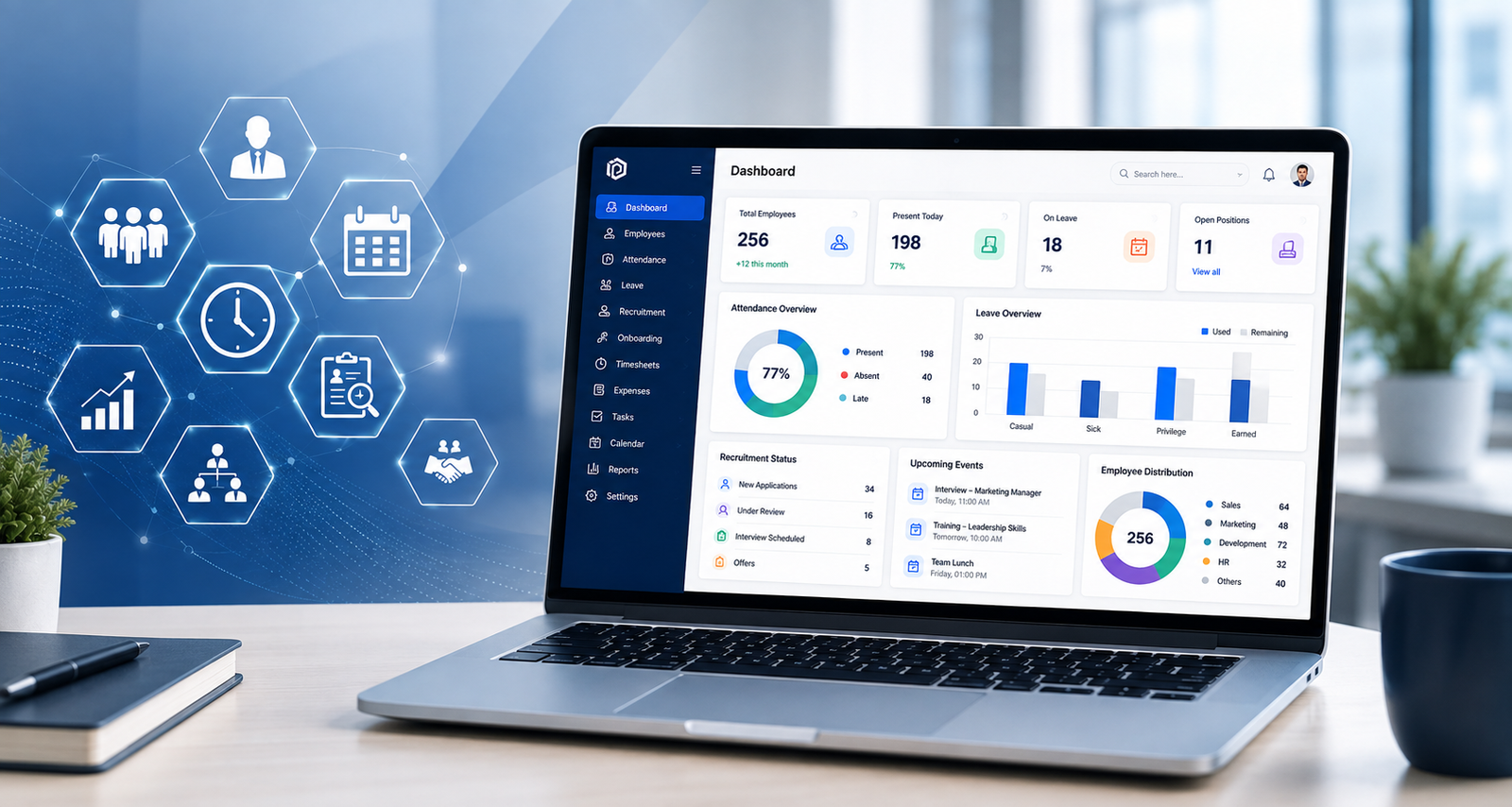
The DiracERP Human Resource Management module enables organizations to manage the entire employee lifecycle from a single platform.
Key capabilities include:
- Employee Information Management
- Attendance Management
- Leave Management
- Recruitment Tracking
- Employee Onboarding
- Task Management
- Timesheets
- Expense Management
- Performance Monitoring
- Calendar Scheduling
- HR Reports and Analytics
By automating repetitive HR activities, DiracERP helps organizations reduce administrative effort, improve workforce visibility, and build a more productive workplace.
Frequently Asked Questions
What is an HR ERP system?
An HR ERP system is software that centralizes employee information, attendance, recruitment, leave management, payroll coordination, and performance tracking within a single platform.
How does ERP improve HR productivity?
ERP automates repetitive administrative tasks, reduces manual data entry, streamlines approvals, and provides real-time information, allowing HR teams to focus on strategic initiatives.
Can ERP automate attendance management?
Yes. Most ERP systems integrate with biometric devices, mobile applications, and web portals to automate attendance tracking and generate accurate reports.
Is ERP useful for small businesses?
Absolutely. Small and medium-sized businesses benefit from ERP by reducing manual work, improving organization, and preparing their HR processes for future growth.
Does ERP help with employee recruitment?
Yes. ERP software manages job postings, candidate applications, interview scheduling, hiring workflows, and onboarding from a centralized dashboard.
Conclusion
Human Resource Management is evolving rapidly, and organizations need technology that enables HR teams to work efficiently while delivering a better employee experience.
An ERP system brings together employee records, attendance, recruitment, leave management, task tracking, communication, and reporting into one integrated platform. The result is fewer administrative burdens, improved accuracy, better collaboration, and more informed decision-making.
Whether you’re a growing business or a large enterprise, investing in a modern HR ERP solution can significantly improve workforce management and support long-term business success.
If you’re looking to simplify HR operations, DiracERP provides a comprehensive Human Resource Management solution designed to help organizations automate processes, improve productivity, and manage employees more effectively.